How to design primers: the rules and how they change by purpose
A good primer binds only where you want, at the temperature you want, without interfering with its partner. This guide puts numbers on those three rules and explains how qPCR and cloning primers differ.
Paste a template for suggested primer pairs that follow these rules, or check your own primers for Tm, dimers and hairpins in plain words — with one-click Primer-BLAST.
Open primer design & check →1. The rules at a glance
| Item | Recommended | Why |
|---|---|---|
| Length | 18–25 nt | Too short binds elsewhere; too long adds secondary structure and cost |
| GC content | 40–60% | Too low binds weakly; too high binds non-specifically |
| Tm | 55–65 °C, pair within 3 °C | Both must bind well at one annealing temperature |
| 3′ end | 1–3 G/C in the last 5 bases; ending in G or C helps | Extension starts at the 3′ end — too weak won't extend, too strong extends anywhere |
| Repeats | No more than 4 identical bases; avoid AT/GC repeats | They slip and misprime |
| Dimers, hairpins | ΔG involving the 3′ end above −5 kcal/mol | Primers that pair and extend make primer-dimer products |
Tm differs by a few degrees between calculators and salt conditions. Compare both primers with the same calculator and treat the absolute value as a guide.
2. Reverse primer orientation — the most common mistake
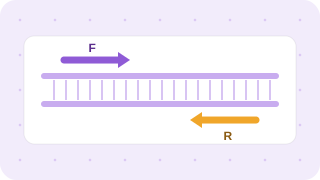
The forward primer is copied directly from the template; the reverse primer is the reverse complement of the far end. Both are written and ordered 5′→3′.
Forward = ATGGCTTCCACC · Reverse = GTTCAAGGTACC
If the reverse is copied as-is, both primers face the same way and no product forms. A design tool with the template handles orientation for you.
3. What is different about qPCR primers
- Products of 70–200 bp copy completely each cycle, so efficiency is stable.
- Span an exon–exon junction: a primer across an exon junction, or primers in different exons separated by a long intron, will not amplify contaminating genomic DNA.
- 90–110% efficiency and a single melt peak: confirm with a standard curve from a cDNA dilution series (slope −3.1 to −3.6) before use.
- Two-step SYBR at 60 °C is standard, so aim for Tm near 60 °C.
Checking published or database-validated primers (e.g. PrimerBank) first is also worthwhile — but still confirm efficiency and melt curves in your own conditions.
4. Cloning primers carry a "tail"
Cloning primers add the needed sequence to the 5′ end of the template-binding part (18–25 nt, set by Tm).
| Method | 5′ addition |
|---|---|
| Restriction cloning | 4–6 extra bases + restriction site (+ Kozak GCCACC for expression) |
| Gibson · HiFi | 20–30 nt identical to the vector end |
| In-Fusion | 15 nt identical to the vector end |
| Golden Gate | Extra bases + Type IIS site such as BsaI + 4-nt overhang |
Calculate Tm from the binding part only. Including the tail inflates the Tm and leads to the wrong annealing temperature.
5. Two things to do after designing
- Check specificity with NCBI Primer-BLAST to see whether other genes also give products (how-to).
- Order and resuspend: desalted purity is enough for routine PCR and qPCR; long cloning primers (>40 nt) sometimes get a higher purification grade. On arrival, make a 100 µM stock from the nmol on the tube (nmol × 10 = µL to add) and use a 10 µM working dilution.
Paste a template for suggested primer pairs that follow these rules, or check your own primers for Tm, dimers and hairpins in plain words — with one-click Primer-BLAST.
Open primer design & check →